MRA March 2026 Meeting Minutes
1. General MRA Updates (Presented by Darryl)
The MRA is currently looking for a volunteer to take over the liquor portfolio, as interested parties have recently pulled out.
A scheduled meeting with the CRUM department regarding problem properties in the area was canceled by the councillor 12 hours prior and is in the process of being rescheduled.
The MRA met with the DA regarding a court case over water issues and will share more information with residents as it becomes available.
2. Land Use and Property Updates (Presented by Lone)
The MRA is tracking several problematic properties in the neighbourhood and asking residents to submit formal objections where applicable:
Motorbike Shop (3rd Avenue): The deadline for objections is Thursday. The property submitted plans only for a garage, despite the workshop activities extending to the back and the property acting as a commune. The space was previously used as a random spaza shop.
PC Hotel (31 and 32 4th Ave) : The building is half-demolished with no applications submitted for a hotel, commune, or boarding house. The building inspector has acknowledged the MRA's complaint.
71 2nd Avenue: Construction is ongoing and it is rumoured to be student accommodation, but no building plans or commune consent forms have been submitted to the city.
95 5th Avenue: A heritage house was illegally knocked down and left empty for at least 10 years. Foundations are now being built for a new structure, but it is unclear what is being constructed.
Property Opposite Café Picobella (59 4th Ave): There is a Property24 listing stating they have permission for four independent, double-story units. A "Res 4" approval appears to have slipped through the tribunal without the community receiving proper notification.
59 4th Avenue: There are questions regarding whether this property has changed hands, as it appears to be on auction.
3. Melville Art Mile Update (Presented by Aubrey)
The Melville Art Mile is a community art event that takes place on the first Thursday of every month.
The initiative features up to 20 venues and includes local artists, galleries, and home studios.
An NPC (Non-Profit Company) called the Melville Art Mile Association has been established to protect and support local creatives.
The Melville Security Initiative (MSI) assisted by providing security for the inaugural event.
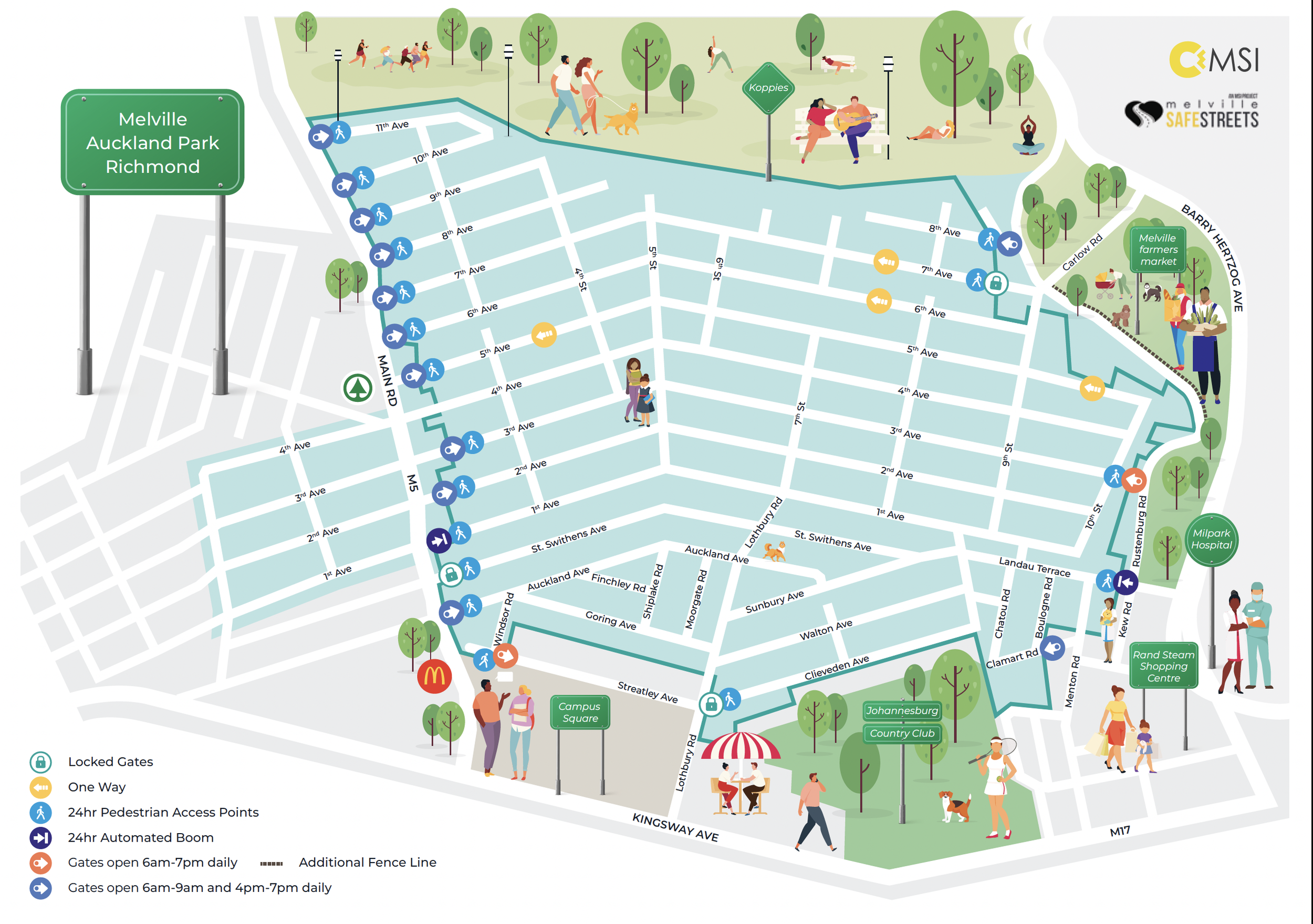
The new Safe Streets map
4. Safe Streets Project (Presented by Hanko & Danny from MSI)
The bulk of the meeting focused on the Melville Safe Streets project and the pushback from the city regarding road closures.
Initial Plan vs. City Approval:
The original community plan to boom or gate 21 to 22 intersections was rejected by the Johannesburg Roads Agency (JRA).
The JRA dictated that four main entrances must remain completely open 24/7 with no structures or booms allowed.
These four open entrances are 4th Avenue, Menton Road , Lothbury, and 9th Street.
Streets with gates must be open 06:00 to 09:00 and 16:00 to 19:00.
Furthermore, the JRA ruled that no pedestrian gates are allowed to be locked at any of the closure points at any time, meaning pedestrian access cannot be restricted.
Current Strategy & Next Steps:
MSI plans to use the infrastructure that was approved and build a revised security plan around it.
This plan will rely heavily on Public Space Patrolling and leveraging existing security companies, such as Beagle Watch, which currently services 700 households in the area.
MSI will draft a final, costed security plan based on these new city restrictions and present it to the community with a proposed meeting in April.
Resident Concerns Raised Regarding the Safe Streets Project
1. Confusing and Contradictory JRA Notices
Map vs. Text Discrepancies: Multiple residents expressed deep frustration with the official notice published by the Johannesburg Roads Agency (JRA). They pointed out that the visual map lacked symbols for several of the proposed closures and directly contradicted the written descriptions.
Unclear Terminology: Residents were confused by phrasing in the JRA notice, such as descriptions of a "24-hour automated manned boom" being placed at locations where the city simultaneously stipulated "no structures allowed."
2. Pedestrian Vulnerability and Foot-Traffic Crime
Day and Night Foot Crime: The city's ruling that unhindered 24/7 pedestrian gate access on every street is allowed was a major sticking point. Residents highlighted that a significant portion of crime in Melville (such as muggings, and theft of laptops and phones) is committed by pedestrians, not just people in vehicles.
Proximity to High-Risk Areas: Residents living near the Koppies and the informal settlement areas noted that leaving pedestrian access completely unlocked 24/7 leaves them incredibly vulnerable to foot traffic at all hours of the night.
3. Crime Displacement to "Open" Streets
The "Funnel" Effect: Residents living on the four designated 24/7 open routes are highly concerned that the closures will simply displace crime and traffic directly onto their streets.
Unequal Protection: There is a fear that the plan will create a "safe" side of Melville and an "exposed" side, with criminals naturally targeting the streets where access is completely unrestricted.
4. Project Viability and Effectiveness
"What is the point?" With four main arteries forced to remain open without any booms or structures and 24/7 unhindered pedestrian access on every road, several residents questioned whether the heavily compromised plan is still worth the community's financial investment.
Emergency & Security Response: Some residents expressed concern that while criminals on foot could easily bypass the physical barriers, armed response vehicles (like Beagle Watch) could get stuck at closed gates while trying to pursue suspects.
5. Daily Logistics and Access
Services and Transport: Questions were raised about how daily logistics would be impacted, such as refuse collection (Pikitup) and school transport. While MSI clarified that refuse trucks would be granted access, school transport vehicles might be forced to alter their routes to use the open arteries, causing potential bottlenecks. All gates will remain open on Pikitup days (Tuesdays & Fridays in Melville).
How to Submit Objections or Comments for Safe Streets
As discussed, it is crucial that residents voice these concerns directly to the city before the deadline. Please share this information with the community so they can submit their formal comments:
Deadline: Friday, 27 March 2026
Submit to Johannesburg Traffic Engineering:
Note: The MRA encourages residents not to simply reject the plan entirely if they want a security solution, but rather to clearly state what specific elements (like the lack of locked pedestrian gates or the unprotected main arteries) they are objecting to so the city understands the community's specific safety needs.